Under våren 2024 kom den tredje omarbetade upplagan av den populära kurslitteraturboken Sociolingvistik (red. av Eva Sundgren) som används på många grundutbildningar i Sverige – och innehåller för första gången ett kapitel om ”Namnens sociolingvistik”! Vid sidan av kapitel om bland annat dialekter och sociolekter, språkkontakter, språkattityder, språkförändring och språkpolitik får läsaren nu också bekanta sig med socioonomastiken som en viktig del av sociolingvistiken. I kapitlet om namnens sociolingvistik, författat av undertecknad, introduceras läsaren till flera namntyper och olika sociala funktioner som namn, namnvariation och frånvaron av namn kan bära i skilda sammanhang. I särskilda avsnitt behandlas teman som namn och identitet, namn och genus, namn och mångkultur, namninnovationer och namntrender samt namnplanering och maktutövning. Beskrivningen är baserad på i första hand aktuell forskning från de nordiska länderna med många tips till vidare läsning. Dessutom finns ett särskilt avsnitt om metoder och etiska överväganden.
Innan 1900-talets början var det relativt enkelt att byta efternamn i Sverige. Den som inte var nöjd med sitt efternamn gick helt enkelt till prästen och bad om att få stå med ett annat namn i kyrkoboken. Kanske opponerade sig prästen mot olämpliga namn, men det vet vi lite om. Efter den första lagstiftningen om efternamn i Sverige, 1901 års släktnamnsförordning, blev det något krångligare att byta efternamn, och med tiden dessutom allt dyrare.
Hur man ansökte om efternamnsbyte
Efter att förordningen trätt i kraft år 1902 var det enligt lagen slut med att endast meddela prästen att man ville byta namn. Det gick förvisso fortsatt att byta från ett -son-namn till ett annat bara genom att meddela prästen. Ville man byta till en annan typ av namn var man enligt förordningen tvungen att skicka en skriftlig ansökan till Länsstyrelsen som sedan beslutade om namnbytet skulle godkännas eller inte. Om namnbytet blev godkänt utfärdades ett bevis som man sedan skulle visa för prästen för att få det nya namnet inskrivet i kyrkoboken.
Ansökan gjordes inte genom en blankett som vi är vana vid idag, utan man fick skriva ett ansökningsbrev. Detta brev skulle innehålla vissa uppgifter i en viss ordning och det var nog svårt för många att exakt veta hur det skulle utformas.
I slutet av 1910-talet tog Ecklesiastikdepartementet och senare Justitiedepartementet över ansvaret för ansökningarna och till dessa skulle man fortsatt skriva ansökningsbrev. Blanketter för ansökan om efternamnsbyte började inte utformas förrän Statistiska centralbyrån på 1950-talet ansvarade för efternamnsbyten. Blanketterna fick under 1960-talet den form de har ännu idag där man bland annat ska ange skäl till varför man vill byta efternamn. Nu, under 2000-talets början, har formerna för ansökan underlättats än mer eftersom det är möjligt att ansöka digitalt.
Hur mycket kostade det att byta efternamn?
I och med släktnamnsförordningen började det också kosta pengar byta efternamn. Under 1910-talet kostade det fyra kronor. År 1922 motsvarade det cirka 132 kr i 2024 års penningvärde enligt Statistiska centralbyråns prisomräknare som börjar just år 1922 (https://www.scb.se/hitta-statistik/sverige-i-siffror/prisomraknaren/). De fyra kronorna var inte en egentlig ansökningsavgift utan pengarna skulle användas till att finansiera kostnaden för de kungörelser i tidningarna som Länsstyrelsen enligt släktnamnsförordningen behövde göra ifall namnbytet blev godkänt.
Det kostade alltså inget att göra själva ansökan. Man betalade bara om namnbytet godkändes och en kungörelse behövdes. När Justitiedepartementet från 1920-talet till mitten av 1950-talet ansvarade för ansökningarna kostade det heller inte något att ansöka. Blev namnbytet godkänt behövde man dock betala 20 kronor (521 kronor i 2024 års penningvärde) för att lösa ut beviset på namnbytet på posten.
Under mitten av 1960-talet, när Patent- och registreringsverket ansvarade för ansökningarna, införde man en ansökningsavgift; ansökan började nu alltså kosta pengar oavsett om den blev godkänd eller ej. Jag ska ge några exempel på ansökningsavgifter som gäller en (1) person som byter till ett nybildat efternamn. År 1964 var avgiften 50 kronor (655 kr) och år 1978 200 kronor (944 kr). I början av 1990-talet kostade det 1 100 kronor (1 966 kr). Dessa avgifter fördubblades om exempelvis flera familjer ville byta efternamn samtidigt. Idag, år 2024, kostar det 1 800 kronor för en person att ansöka om ett nybildat efternamn hos Skatteverket.
Efternamnsbyten förr och nu
Under de över hundra år som man har behövt ansöka om efternamnsbyte har det i vissa avseenden blivit enklare. Gör man ansökan över internet så behöver man inte ens gå utanför dörren. För den som vill byta till just ett nybildat namn har det i andra avseenden blivit svårare, och framförallt dyrare.
Namnlagarna i Sverige ställer, och har ställt, vissa krav på att ett nytt efternamn inte får vara likt andra efternamn eller olämpligt på annat sätt. Den som fram till 1 juli 2017 ville byta till ett nybildat efternamn kunde ange flera önskade namn i samma ansökan för att öka chansen att åtminstone ett av namnen blev godkänt. Idag kan man endast ansöka om ett namn åt gången. Blir den första ansökan underkänd får man betala ytterligare 1800 kronor om man gör en ny ansökan.
Källor
Uppgifter om vad namnbytet kostade under olika perioder har jag hämtat från:
Svensk namnbok 1954. Utarbetad av 1952 års släktnamnskommitté. (SOU 1954:1) Stockholm.
Svensk namnbok 1964. Utarbetad av 1962 års släktnamnskommitté. (SOU 1964:14) Stockholm.
Svenska efternamnsförslag 1992. Namnförslagsböckerna i nyutgåva. Namnenheten Patent- och registreringsverket. Stockholm.
Svenska släktnamnsförslag 1979. Namnbok utgiven av Patent- och registreringsverket. Namnsektionen. Stockholm.
Trotzig, Karl, 1909: Vad bör Pettersson kalla sig? En bok om släktnamn. (Studenföreningengs verdandis småskrifter 83.). Stockholm.
Valet av efternamn vid giftermål erbjuder flera möjligheter i dagens Sverige. Hur fördelningen under de två senaste namnlagarna har sett ut för olikkönade par visade jag 2023 i en bloggartikel utifrån statistik från Statistiska Centralbyrån (SCB) för namnval vart femte år.
Undersökningsperioden var anpassad för att få fram utvecklingen under Namnlagen 1982 respektive Personnamnslagen 2016. En tydlig tendens bland de olikkönade paren är att fler gifta par nu väljer att behålla sitt respektive efternamn; en ökning har skett från 10 % år 1985 till ca 44 % år 2020. Under motsvarande tid har andelen kvinnor som tar mannens efternamn minskat från 84 % till 43 %.
Männen tycks dock fortfarande ha svårt att byta bort sitt ogiftnamn; andelen som gjort detta har varierat mellan 2 och 8 % under perioden. Att det sedan 2017 är möjligt för båda parter att bära ett dubbelt efternamn har inte heller varit något som många män hittills övervägt. Av de 10 % av paren där någon eller båda 2020 antog dubbelt efternamn var det i endast en tredjedel av dessa äktenskap en man som gjorde så. Det tycks alltså vara kvinnan som agerar i namnfrågor, som antar dubbelnamn eller byter namn.
Olika möjligheter för samkönade par att välja efternamn
Sedan 1995 har samkönade par i Sverige kunnat registrera partnerskap och sedan 2009 kunnat ingå äktenskap. Äktenskapslagen gjordes då helt könsneutral. Enligt SCB har det varit vanligare att kvinnliga par gifter sig.
Vilka efternamnsval har dessa par gjort? Här finns ju inte någon etablerad norm att den ene ska anta den andres namn. De olika möjligheterna som stått till buds har varit (liksom för olikkönade par):
att båda behåller sina respektive efternamn
att den ene tar den andres efternamn och avstår från sitt eget ogiftnamn
att båda tar ett nytt gemensamt efternamn
att den ene tar den andres efternamn och behåller sitt eget som mellannamn (möjligt t.o.m. 2016)
att båda tar ett dubbelt efternamn bestående av bådas ogiftnamn (möjligt fr.o.m. 2017)
att den ene tar ett dubbelt efternamn medan den andre behåller sitt (möjligt fr.o.m. 2017)
Utvecklingen för samkönade pars val av efternamn
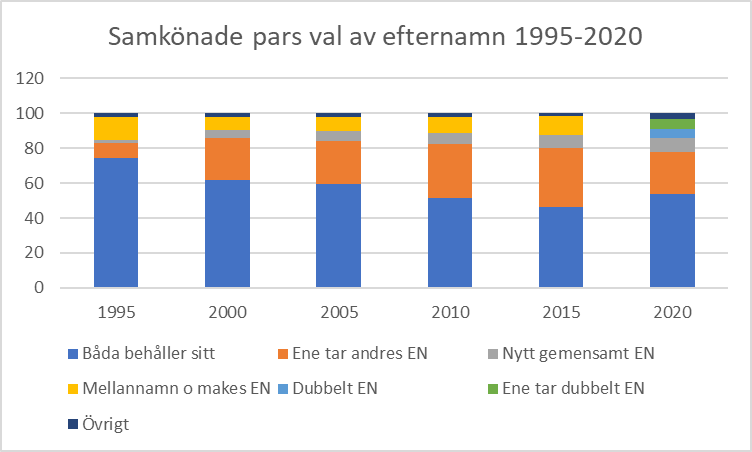
Jag har använt motsvarande statistik från SCB som för de olikkönade parens namnval, men då för åren 1995 till 2020 eftersom 1995 är första året då samkönade partnerskap kunde registreras. Resultatet visas procentuellt i diagrammet. Det är värt att påpeka att siffrorna för de äldsta årtalen är låga; år 2000 registrerades endast 149 giftermål medan den högsta siffran gäller 2015 med 558 stycken.
Diagram 1. Procentuell fördelning av samkönade pars val av efternamn. EN = Efternamn. Källa: SCB. Registret över totalbefolkningen 31/12 aktuellt år samt 31/12 året innan aktuellt år.
Den vanligaste modellen för alla år är att båda parter behåller sina respektive namn burna före äktenskapet. Andelen sjunker dock fram t.o.m. 2015 men ökar något igen 2020. Gruppen där den ene tar den andres efternamn ökar fram till 2015 då den bestod av en dryg tredjedel av giftermålen. Övriga grupper har hela tiden varit små med omkring 20 % av paren varje år.
Viktigare med gemensamt efternamn idag?
Att paren antar ett nytt gemensamt efternamn är en ökande företeelse, och för år 2020 ses att nyheten att kunna bära ett dubbelt gemensamt efternamn tycks tilltala vissa par. Utifrån statistiken kan antas att någon form av namngemenskap förefaller ha blivit viktigare under perioden, vilket alltså skiljer sig från resultaten för de olikkönade parens namnval.
Dessvärre ger inte siffrorna besked om fördelningen mellan manliga och kvinnliga par så om någon skillnad finns dem emellan kan inte utläsas. Enligt SCB:s allmänna befolkningsstatistik är det fortfarande vanligare att kvinnliga par gifter sig än att manliga gör det men för att utröna om och hur detta påverkar namnvalet skulle ytterligare undersökningar krävas.
I min tjänst vid Institutet för språk och folkminnen, inom det förutvarande Namnarkivet i Uppsala (som i sin tur gick tillbaka till Ortnamnsarkivet i Uppsala och Sveriges medeltida personnamn) ingår att årligen skriva en bloggtext, som ska vända sig till den intresserade allmänheten.
Syftet med listan är att försöka standardisera stavningen av historiska personnamn, vilket jag fann rätt intressant. Men av någon anledning fastnade jag för ett kvinnonamn Ingemo, som uppgavs vara fornsvenskt (utvecklat från Ingemodh, se Otterbjörk, Svenska förnamn) och efterreformatoriskt och förekommande i Småland. Det blev nu ämnet för min text: ”Kvinnonamnet Ingemo – eller vad hände under det förra 00-talet?”.
Ämnet var alltså mer eller mindre valt på måfå, men förvånande nog rönte den ett för våra förhållanden livligt intresse när den delades på vår facebooksida. Resultatet var väl delvis slumpartat men kom sig väl också av att den kunde appellera både till släktforskare och till sådana som råkade känna en Ingemo. (En intressant upplysning som kom fram i kommentarerna var att en persons föräldrar valt Ingemo efter att ha läst Erik Dahlbergs Svecia, där Ingemo källa förekommer.) Förmodligen var det också positivt att jag nästan helt lyckades undgå att skriva om medeltiden som är min vanliga tidsperiod.
Från onomastisk synvinkel är namnet principiellt intressant, vill jag hävda, framför allt i hur det kom att återupplivas vid början av 1900-talet i Finland och Sverige, sannolikt (gissar jag) genom att det aktualiserades i strödda tidningsartiklar om ”offerkällan” Ingemo källa i Västergötland under en lång följd av år, men även i hur det kom att dö ut, i alla fall i ett fall.
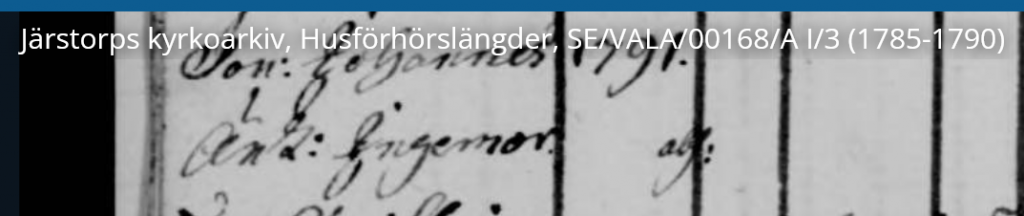
Den hittills sist kända namnbäraren av det historiska namnet uppträder 1812 i en bouppteckning: Ingemo Månsdotter i Järstorps socken, Småland. Hon skrivs dock märkligt nog Ingrid i kyrkliga källor, skriver jag i bloggtexten. Min kollega Leila Mattfolk lyckades dock hitta skrivningar av henne som Ingemo och även som (troligen) Ingemor, en namnform som är känd från 1900-talet och som rimligen beror på association till namn som Lillemor. Denna association förekom alltså redan i ett kyrkligt dokument från 1780-talet. Någon kontinuitet till 1900-talets Ingemor kan knappast finnas.
Förutom urspårningar kunde man möjligen skylla Ingemo Månsdotters varierande namnformer på beröringsskräck från prästerskapets sida till den katolska (eller som hedniskt betraktade) Ingemo källa. Det vore intressant om det ginge att få tag på större material om de sista namnbärarna och komma på fastare mark.
In Norway we have had fixed surnames for, roughly speaking, a century. The first Norwegian name law came into place in 1923. Every child born after this would be given their father’s last name, or if the parents were unmarried, either their mother’s or their father’s last name. Hence, last names that had previously changed from one generation to the next, or when the name user moved from one farm to another, now became fixed surnames.
The main purpose of the law was to create order amongst the lower classes in society, making it easier for the police, the poor people’s aid, and others to know which individuals they were in touch with. One way of doing so, was to make sure they kept the same last name throughout life. Unless you were a woman, as women should take their husband’s surnames, and the children should get their father’s surname.
Law and order were needed to avoid misidentification amongst the lower classes in society, in effect making all Norwegians follow the norms that had become practice for the higher classes during the 19th century. Turning such a practice into law, would also ensure that Norway followed suit with other, as was argued, more modern European countries (Department of Justice and Police 1922).
But my aim here is not to write about how the practices changed during the decades before and after 1900 (for this, see for example Utne 2001; Torp 2018; Utne 2011). Rather, my aim is to write about how the naming practices of the 1923-law, by the 2010s was described in terms of tradition rather than law by Norwegian men. I wrote my PhD-thesis about Norwegian men in heterosexual relationships and their name choices in couples, and this article is based on a chapter where I discuss the meaning of tradition in surname choices (Grønstad 2020, 153-207).
Method and material
First, a few words about method and material. The material consists of responses from self-identified men on two qualitative questionnaires, i.e. lists of open-ended questions, on surnames and surname choices. In the first questionnaire (2014), aimed at a general Norwegian reading public, these questions had to do with surname changes by the person responding to the questions, or by persons close to them, thoughts of children’s surnames and accounts of reactions from others on the name choices. The second was aimed specifically at men who had changed their surnames to their wife’s or woman partner’s surname (2016). I did close readings of the 101 responses from men to the first questionnaire, plus the 60 responses to the second, to discover potential themes and patterns.
The current surname situation for Norwegian couples
Before I go into these themes and patterns, I wish to provide some more information on the choices Norwegian men and women make. As part of my PhD-work I developed statistics for the situation in 2018 amongst Norwegian couples (Grønstad 2020, 105-109). Those who were married or had been married during the first two decades of 2000s were included in the sample. Most Norwegian men kept their surnames when they married. Between 4 and 5% took their wife’s surnames as their own surnames. A few more combined their surnames with their wife’s, either with a hyphen or by taking it as a middle name. In Norway a middle name is a name of surname type, that is placed after the first names. Formally it counts as a first name, not as a surname.
Type of action
Women
Men
Kept the full name unchanged
41%
87%
Took the partner’s surname only
26,5%
1,8%
Took the partner’s surname as a middle name
6,2%
4,2%
Took the partner’s surname. Kept the previous surname as a middle name
20,1%
2,4%
Hyphen
1,5%
2,2%
Other
4,7%
2,4%
Total
100%
100%
Table 1. These are the different choices made by men as a group compared to women as a group.
Women take their partner’s surname to a much higher degree. Almost half of the women change their surnames, and almost half keep their surnames. A very few women hyphen their surnames with their partner’s. For some of the women changers, surname continuity is ensured to a certain degree through keeping their original surname as a middle name, and some of the women who keep their surnames, take their partner’s surname as a middle name.
Keeping and using men’s surnames as tradition
One theme in the responses to the two quantitative questionnaires was an understanding of the past in the present, often described as “tradition”. Throughout, tradition within surname choices equalled the use of the men’s surnames, meaning that men kept their family name throughout life, women change in marriage with men, and children get their father’s surname. These were the practices formulated as law in 1923, and kept and slightly amended in 1949, and 1964. The laws regarding surname choices was made gender equal in 1979 and came with even more possibilities in the newest law from 2003. One example is the possibility to connect two surnames with a hyphen, which was not a possible option before 2003.
The men positioned themselves in relation to certain understandings of tradition, and I found three such patterns. Within the first pattern, tradition as preference of men’s surnames was taken for granted, and tradition was associated with something positive. Within the second pattern, tradition was also understood as the preference of the man’s surname, but here this tradition was criticized or even outrightly dismissed. Within the third pattern, tradition was re-imagined in new ways, and these men drew on notions of continuity and connections with past relatives and practices, while adding a perspective of gender equality to the mix.
The first pattern
Amongst older men and name keepers in marriage more generally, the understanding of tradition as something worth following, or practices that could be taken for granted was quite common. One man wrote that he married almost 50 years ago during a time when “the old naming traditions was common where I lived” (born in 1938). Following tradition had certain values, and this tradition supported men as a group, affording them surname continuity through life as well as the possibility of sharing surnames both with their birth family and the nuclear family of their own creation. Another man who kept his family name when he married in the late 1970s, wrote: «It has never been a topic to change or not to change […]. [An a]lternative situation is so hypothetical that I have no answer to this» (born in 1952). Theirs was a privilege some of the younger men no longer took for granted:
«I wish to continue the family name, and I am the only one from my generation who can do that. This feels like a very patriarchical and paternalistic point of view, something I am not 100% comfortable with, but I still feel like this is something I really wish to do» (born in 1983).
He grew up in the 1980s and 1990s and saw gender equality as important. This made it difficult to take surname continuity for granted even though he was a man.
The second pattern
Some took this reflexivity further, by questioning the basis for the tradition. One argument was that the interpretation of tradition as using the man’s surname was a newer custom, and that the older custom had been for both husband and wife to keep their surnames as these were usually their father’s first name with a -son or -daughter attached. The couple would change additional surnames whenever they moved, as the name of the farms they lived on, often provided a combined last name and address. One of the men who took his wife’s surname as early as the early 1980s, argued that present day wedding customs are neither Norwegian nor gender equal. Both women’s surname change and the practice where the father follow the bride up the church floor to hand her over to her new husband “as a package” are imports as well as of a newer date than previous customs, he argued (born in 1959).
The older traditions were both more original and more gender equal. Other men argued that they did not want to follow some “old traditions” at all. One example of this is a man who took his wife’s surname for several reasons. Most importantly for him was that they “wanted to create something of their own rather than just continue with something old” (born in 1991). Just because something was old did not mean it should guide their present-day actions, but it could be dismissed.
The third pattern
Some disregarded traditions completely but the notion of continuity and connection with past practices and ways of life was attractive to some of the men who changed their names:
“When we had children in 2010, we decided to give the children my wife’s surname because it is a name connected to a place where she has roots and with a strong family tradition, a name which is unique to her kin, while my name had no history, no connection to a place, and many others that we are not related to, also share it” (born in 1983).
Instead of taking the concept of tradition to equal the use of the man’s surname, these men looked at the surnames and searched for name continuity with the past, either through choosing the wife’s last name and her name continuity, or by choosing to give their children new names based on older customs such as using the first name of one of the parents with a -son or -daughter attached.
Conclusion
Tradition is a vital concept in the understanding of surnames, both among men who keep their last names and men who make changes. Tradition understood as the preference of the man’s surname, work as a guidance to action that favour men and men’s lineage. Breaking with tradition may come with a cost not all men are willing to pay. However, leaving gender out of the equation, shifting tradition to mean continuity with the past, the concept of tradition may continue to be important and vital. It may add more possibilities to think about surname choices for all, not only women.
Förr i tiden försvann namn ibland, någon som har förklarats med att kulturella förändringar, såsom kristendomens införande, har påverkat namnskicket så att många förnamn byttes ut. Att studera namns försvinnande i modern tid är dock betydligt mer komplicerat. Försvinner ens förnamn längre?
Under de senare seklerna har några stora förändringar vad gäller namnskicket ägt rum. En av dessa är införandet av flernamnssystemet som tillåter att svenska barn i teorin bär hur många förnamn som helst, även om bara ett av dem används som tilltalsnamn. En annan är det ökande inflödet av namn som hör till något annat kulturområde eller till andra etniska grupper. Som en konsekvens av bland annat detta kan man notera att antalet förnamn i Sverige ökar. År 1973 fanns ca 80 000 förnamn i Sverige (Allén och Wåhlin 1995:11) och enligt SCB finns för närvarande ca 441 000 förnamn (238 000 olika kvinnonamn och 203 000 olika mansnamn).
Den första skillnaden mellan ett namns och ett vanligt ords existens är att det behövs någon att namnge för att namnet ska vara synbart. Samtidigt kan mycket väl ett namn bevaras i någons minne, för att om tillfälle ges användas igen, även om namnet inte har burits på lång tid. Det skulle alltså gå att hitta gamla förnamn genom t.ex. släktforskning, eller en vandring över kyrkogårdar.
Man brukar räkna med att förnamnens popularitet går i cykler om ca 100 år, men tack vare flernamnssystemet kan de ligga och pyra utan att de syns. I slutet av 1800-talet och tidigt 1900-tal var det många flickor som fick t.ex. namnen Augusta, Gustava och Oskaria, men det är svårt att se att det runt millenniumskiftet, hundra år senare, fanns något större intresse för dem bland namngivarna. De här namnen verkar ligga pyrt till, även om de fortfarande existerar i vårt gemensamma onomastikon.
Men det kanske inte är själva namnformerna som är intressanta, utan namntrenden? Runt år 1900 var det t.ex. modernt med namn som hade en betydelse som uppfattades som genomskinlig av namnbrukarna, t.ex. Hulda, Milda, Rara. Nu för tiden är troligen inte kopplingen till betydelsen lika självklar för namngivarna och därför kanske just dessa namnformer är utbytta mot andra mer genomskinliga namn, t.ex. Lykke / Lycke och Tindra och Ängla?
Slutligen, hur är det med ett namn som Adolf, vars popularitet har rasat efter 2:a världskriget? Kommer det att bli modernt igen, eller kan det snart betraktas som lika utdött som vikinganamnet Orm?
Det juridiske grundlag for navneforandringen var loven af 1. april 1905 – en lov jeg også tidligere har omtalt i denne blog. Her skriver jeg blandt andet om hvordan loven egentlig var en tillægslov til navneforandringsloven af 22. april 1904, og fortsætter: “I sin relative enkelthed gav [tillægs]loven mulighed for at man inden nytåret 1905-06 gratis kunne ansøge den lokale politimester om at tage et tilnavn som slægtsnavn hvis man i de sidste 20 år havde været alment kendt under tilnavnet og i øvrigt selv anerkendte sig det.”
1800-tallets navnelovgivning havde utilsigtet medført at den støt stigende befolkning bar de samme efternavne; især patronymer såsom Jensen, Nielsen, Hansen med videre toppede listerne.
Mens ånden i navnelovgivningen i 1904-05 egentlig var at skabe en større variation i slægtsnavnene i Danmark, medførte lovens bogstav at Clemen i 1905 kunne få lov til officielt at erstatte det mere ualmindelige slægtsnavn Havkrog med noget så almindeligt som Jensen. Navnet Jensen var op gennem det 19. og 20. århundrede det mest almindelige efternavn i Danmark. Først i 2016 overhaledes det af patronymet Nielsen.
Hvad hed Clemen sådan rigtigt?
Man skal ikke beskæftige sig længe med slægtsforskning og anden personalhistorisk forskning før man opdager at en persons navn ikke gengives på samme måde på tværs af de historiske kilder. Eksemplet med Clemen viser til fulde hvad jeg mener.
Ved fødsels- og dåbsoptegnelsen fra 1836-37 i kontraministerialbogen (kirkebogen) fra Nordby Sogn, skrives hans navn Clemmen Jørgen Haukrog. Samme staveform går igen ved hans konfirmation i 1851. I 1865, hvor han blev gift i Besser Kirke, staves hans navn Clemmen Jørgen Havkrog, altså med -v- i stedet for -u- i slægtsnavnet Havkrog. Så langt vidner kirkebøgerne kun om en lille stavevariation i slægtsnavnet. Folketællingerne (FT) derimod vidner om en større variation, her opsat i kronologisk rækkefølge:
Allerede i 1840 hvor Clemen er fire år gammel, optegnes han altså med efternavnet Jensen og ikke Havkrog; faktisk optegnes han i eksemplerne ovenfor kun med navnet Haukrog i 1845 og 1850. Bemærk her at Clemen altså først i 1905 officielt tog navneforandring fra Havkrog til Jensen som ellers står anført som hans efternavn gennem hele anden halvdel af 1800-tallet og i 1901.
Det er værd at fremhæve at Clemen på et tidspunkt inden for årene 1850-1855 flyttede hjemmefra, og derfor har han i folketællingerne fra og med 1855 sandsynligvis selv meddelt sit navn da folketællingen fandt sted. Ved folketællingerne 1840, 1845 og 1850 var Clemen hjemmeboende, og det har i praksis nok været forældrene, sikkert Clemens far og husstandens overhoved, der meddelte hvad familiens medlemmer hed.
Uanset hvordan navnene helt lavpraktisk blev optegnet i folketællingerne, blev Clemen i de fleste tilfælde opført med det Jensen han, jævnfør navneforandringen i 1905, selv opfattede som sit efternavn.
Clemen var jo ‘søn af Jens’
Efternavnet Havkrog var for Clemen sandsynligvis bare et navn han var blevet tillagt ved dåben. Clemens storebror fik allerede det særlige slægtsnavn da han i Nordby Sogn døbtes Morten Jørgen Haukrog i 1829, så da Clemen døbtes i 1837, fik han samme slægtsnavn. Således er brødrenes slægtsnavn Havkrog måske snarere et produkt af præstens forsøg på at leve op til ånden i dåbsforordningen i 1828 om at tillægge nyfødte børn faste slægtsnavne, noget som netop præsten i Nordby Sogn på Samsø fremhæves for at gøre, jævnfør side 65 og 118 i værket Dansk Navneskik fra 1899.
Men Havkrog har som slægtsnavn sikkert været fremmed for Clemen. Hans far hed Jens Clemmensen, stedvis benævnt Jens Rysser, og Clemens mor hed Ane Jørgensdatter. Når Clemen kaldte sig Jensen, er det altså et primærpatronym, det vil sige fars fornavn Jens efterfulgt at -(s)en ‘søn’. Clemen konstaterede altså at han var ‘søn af Jens’. Man kan altså formode at navnet Jensen har været en langt mere personlig og identitetsbærende konstatering for Clemen end det for ham upersonlige Havkrog.
I en 1700-talsdopbok från staden Gamlakarleby i svenska Österbotten påträffas två belägg på kvinnonamnet Perpetua (1712, 1714) (HisKi). I båda fallen rör det sig om ett utomäktenskapligt barn. Namnvalet är iögonfallande, eftersom namnfattigdomen var påtaglig under förra hälften av 1700-talet, och de flesta flickor fick då frekventa namn som Anna, Brita, Karin eller Maria. Vilken funktion hade namnet Perpetua vid den dåvarande dopnamnsgivnigen? Förekom namnet också på annat håll i Finland, och om så, vem döpte sin dotter till Perpetua?
Helgonnamn
Perpetua är ett helgonnamn från den katolska tiden och enligt Hanks m.fl. (2019) var Perpetua en ung, gift adelsdam som tillsammans med sin tjänarinna Felicitas antog den kristna tron och därför fick gå en martyrdöd till mötes år 203. Senare blev de helgonförklarade av den katolska kyrkan.
Helgonnamnet Perpetua ingick länge också i de finländska almanackorna. Enligt Nivanka (1957) var namnet med redan i den första finländska almanackan år 1705 och det ingick i namnlängden ända till slutet av 1930-talet, visserligen med ett antal kortare avbrott i kontinuiteten. Detta namn, som enligt Brylla (2004) betyder ’evig’, fanns alltså till buds för finländska namngivare genom den lilla skrift som kom ut årligen. Perpetuas namnsdag inföll den 7 mars. Numera ingår endast kortformen Tua i dagens finlandssvenska almanacka (den 7 maj) (Universitetets almanacksbyrå).
Sällsynt namn med bred geografisk spridning
Enligt Myndigheten för digitalisering och befolkningsdata är namnet fortfarande i bruk, men mellan åren 2020–2023 uppgick antalet namnbärare inte ens till tio. Intressant är att namnet förekommer både som mans- och kvinnonamn. Perpetua är också historiskt sett ett sällsynt namn. En sökning på namnet Perpetua som dopnamn i databasen HisKi ger en lista på 26 barn som fått namnet under tiden från 1600-talets slut fram till senare hälften av 1800-talet i Finland. Delar man upp den studerade perioden i femtioårsperioder får man en överblick över namnets kronologiska spridning: 1700–1749 2 belägg, 1750–1799 2 belägg, 1800–1849 11 belägg och 1850–1899 11 belägg.
Namnet har alltså genom tiderna varit sällsynt som dopnamn, men aldrig fallit helt ur bruk. Det har använts både på svenskt och finskt håll i landet och det har haft spridning över stora delar av landet. Perpetua är belagt i dopböcker åtminstone i Österbotten, Birkaland, Egentliga Finland, Nyland, Kymmenedalen och i det gamla Viborgs län.
Social markör – på både gott och ont
De två första beläggen på Perpetua var alltså dopnamn på utomäktenskapliga flickor på 1710-talet. Frågan är vem som valde namnet och vilken funktion det hade vid namngivning. Att Perpetua var en markering för barnets låga sociala status är väl uppenbart, men det är svårt att med säkerhet säga om det var fråga om ett kompenserande eller ett stigmatisande namn. Detta finns det inget säkert svar på, men med tanke på att de utomäktenskapliga barnen onekligen hörde till de utstötta i samhället är den senare tolkningen mer sannolik. Prästens roll vid namngivning under denna tidiga period går inte att underskatta. Det var kanske han som bestämde barnets placering i det sociala nätverket.
Av de sammanlagt 26 flickorna med namnet Perpetua är faktiskt fyra utomäktenskapliga (1712, 1714, 1839, 1894), något som torde tala för att namnet mycket väl har kunnat användas till att peka ut flickor födda utanför äktenskapet. Intressant är emellertid att de övriga flickorna med detta namn inte tillhörde de lägre samhällsskikten utan snarare tvärtom. Nio av de 26 flickorna var döttrar till högre eller lägre tjänstemän, två till militärer och tre till präster och/eller lärare. Åtta av flickorna var döttrar till besuttna bönder eller motsvarande. Två av flickorna i den sistnämnda gruppen hade visserligen blivit nöddöpta – en omständighet som också kan ha avgjort det speciella namnvalet. Anmärkningsvärt är att namnet inte tycks ha använts av allmogen, t.ex. de obesuttna, arbetarna och tjänstefolket.
Det går alltså inte att säga att Perpetua uteslutande är ett lågstatusnamn, även om de utomäktenskapliga barnen kan anses vara välrepresenterade bland namnbärarna. Däremot kan det konstateras att det är ett polariserande förnamn som får sin funktion bestämd i den aktuella socioonomastiska kontexten. Det pekar ut sin bärare antingen i negativ eller positiv belysning.
Källor
Brylla, E. (2004), Förnamn i Sverige: kortfattat namnlexikon. Liber.
Nivanka, E. (1957), Suomalaisen almanakan nimipäivät ja kiinteät juhlapäivät vuosina 1705–1955. I: Vilkuna, K. et al. (utg.). Suomen almanakan juhlakirja. Weiling & Göös.
By Krister SK Vasshus, PhD-student at the University of Bergen
Many modern Scandinavian names have a deep linguistic history, and they come in many shapes and forms. Helge, Torkil, Arnhild and Inger are just a few examples. Names of this type all have in common that they are based on words that carried a semantic meaning at the time when they were formed. They could be formed based on verbs (such as Wīgaz from a verb meaning ‘to fight’), nouns (such as Aud, meaning ‘wealth’), or adjectives (such as Braidō, based on the adjective meaning ‘broad’). Most of the names used during the Scandinavian Iron Age and Viking Age are no longer in use today, but many are still fairly popular. Some of these names have even gotten more popular over the last two centuries due to the popular interest in the Old Norse literature and culture.
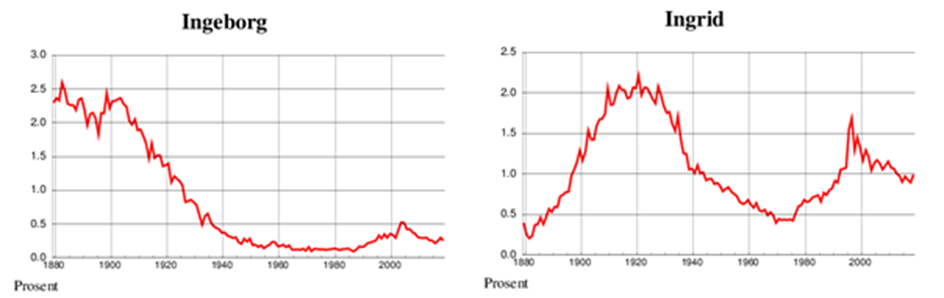
Graphs showing the popularity of the names Ingeborg and Ingrid in Norway the last 130 years. Source: ssb.no.
Names of Scandinavian origin can be formed based on one single word, often with the addition of a suffix. Examples hereof are Arne (meaning ‘eagle’), Karl (meaning ‘man’), and the above mentioned Wīgaz. But they can also be compounded from two words, such as Sigrun, Ingeborg and Wōdurīdaz. Names based on two words are often called dithematic personal names. The oldest written evidence we have of Germanic languages is written on a bronze helmet with Etruscan letters, dated to about 200 BCE, and this inscription contains the dithematic name Harigasti (‘warrior-guest’).
Even though names are formed on the basis of words from the source language, it may some times be impossible to determine what the original meaning may have been. A view commonly held by researchers of onomastics, is that the semantic content of a personal name deteriorates quickly after being used as a name. According to this view, Wōdurīdaz was not a wild and angry (which is the semantic meaning of wōdu-) horsebackrider (the semantic meaning of -rīdaz), and that his parents did not give such a name with the intention of giving these qualities to the child. Not all scholars agree with this, though, and some think that names may be seen as a linguistic expression that conveys the same ideas as we see in other artistic expressions of the time, such as metaphors used in skaldic poetry or ornaments on archaeological artifacts. As an example, the warrior-ideal was quite strong in the Viking Age, which is reflected in many names containing words connected to war and battle. Many of the animals we see in the arts, are also used in personal names of this period.
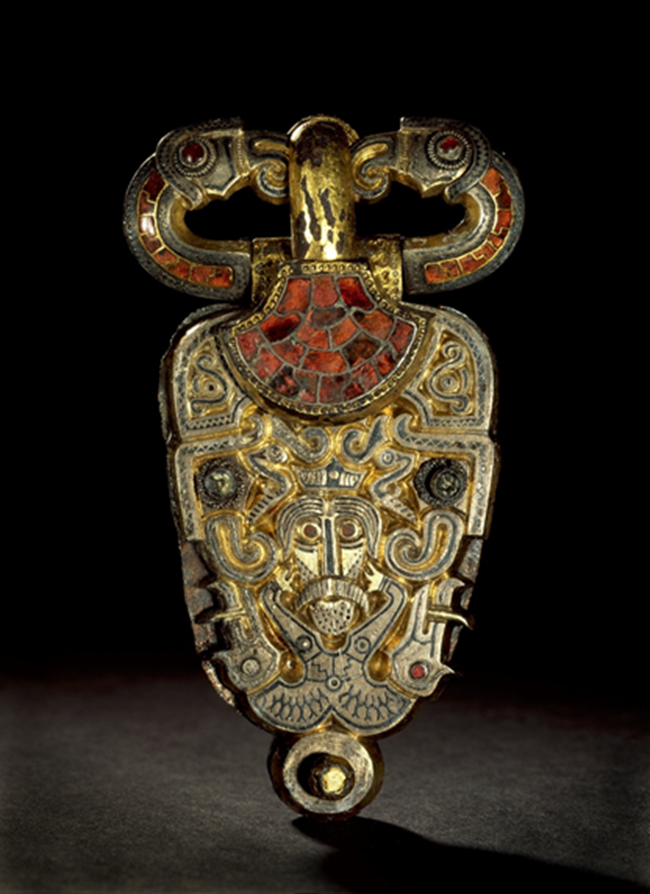
The clasp from Åker in Hamar contains the motif of a man mixed with other animals, which is common for animal art in the Scandinavian Iron Age. The man’s feet are wild boar heads. By the sides of his head there are two eagle heads where the beaks meet the snout of the boar. There are also eagles on the top of the clasp. Both the word for wild boar and eagle were used in personal names during this period. Photo: Eirik Irgens Johnsen / Kulturhistorisk museum, UiO, available under CC BY-SA 4.0.
Judging from runic inscriptions, sagas and traditions up until now, we can see that Scandinavians have three ways one could name someone after another person. Today most people will probably think of naming someone after someone else as the two bearing the same name. Stereotypically this means that a child is named after a grandparent. This type of naming tradition first shows itself in Scandinavia during the Viking Age, and was probably adopted from elsewhere in Europe. The system usually is that the oldest child is named after their paternal grandparent, the second oldest child is named after their maternal grandparents, the third child after their paternal great-grandparents or uncles and aunts. It can, however, be difficult to determine whether a child is named after an aunt/uncle or a great grandparent, as these would share names according to the system.
Another way of naming was by alliteration, where the name starts with the same (or a similar) sound. This is a type of naming we see in the royal Yngling house, where Domalde, Domar, Dyggvi and Dag follow each other in succession. The same dynasty later uses vowels: Aunn, Egill, Óttarr, Aðils, Eysteinn and Yngvarr. This tradition is still in use today, although people are probably a bit more strict on using an identical vowel.
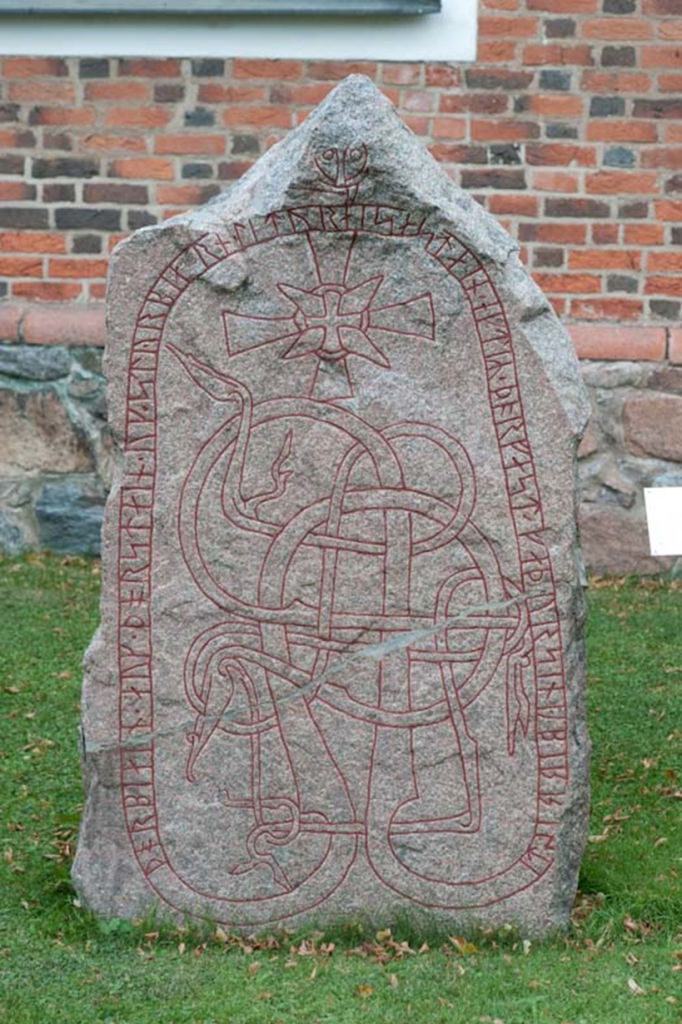
The third way of naming is the principle of variation, which can be used in the dithematic personal names. When a child was named, one could use naming elements that were otherwise used in the same family. This means that a person could be named after more than one family member at once. On the Upplandic runestone U1034 we can read:
þorbiarn·auk·þorstain·uk·styrbiarn·litu raisa stain·eftir·þorfast·faþur sin ybir reisti (Thorbjørn and Thorsteinn and Styrbjørn raised the stone after Thorfast, their father. Øpir carved [the runes]”).
Here we see that Thorbjørn and Thorsteinn are named after their father, as all their names starts with Thor-. Furthermore we see that the brothers Thorbjørn and Styrbjørn share the naming element Bjørn, but we cannot determine whether they are named after someone else in their family, or if it was made to show brotherhood.
Bildetekst: The runestone U1034 show the use of naming based on variation in dithematic names between the brothers Thorbjørn, Thorsteinn, Styrbjørn and their father Thorfast. Photo: Bengt A Lundberg / Riksantikvarieämbetet, available under CC BY 2.5.
This way of naming is still in use in Scandinavia today, and many new names has been made on the basis of this principle (some examples are Kjærlaug, Norunn, Vilfrid, Tryggvald, Norulv and Bjørgny). This principle lead to a substantial amount of dithematic personal names. Gjrotbjørn, Ljotunn, Igulfast, Ulvhild, Geriheid and Wōdurīdaz are examples of names that has gone completely out of use, in contrast to Ingeborg, Bodvar, Gunnhild, Sjurd (from older Sigurd), which has survived to this day.
Exactly why some names survive and some fall out of use, is sometimes difficult to determine. In some cases it may come down to chance, and in some cases we see that a name may live for a long time but only in a very constricted region. And although kinship plays a much less important role in the modern Scandinavian society compared to in earlier times, the naming traditions still show that to some people, it still plays a role.